
Tergel Molom-Ochir
Ph.D. Candidate, Duke ECE
Research Associate, Hewlett Packard Labs
In-memory acceleration of search and reasoning.
I build emerging-device circuits and associative-memory architectures that turn memory into an active engine for AI inference, retrieval, and reasoning.
Research Vision
Modern AI spends much of its time moving data between memory and compute, even when the task is fundamentally a search over stored knowledge. My research asks how memory itself can perform that search and support the reasoning built on top of it.
I work across emerging devices, circuits, and architectures to build associative-memory systems for attention, retrieval, tree search, and test-time computation.
Research Thrusts
01 / DEVICES
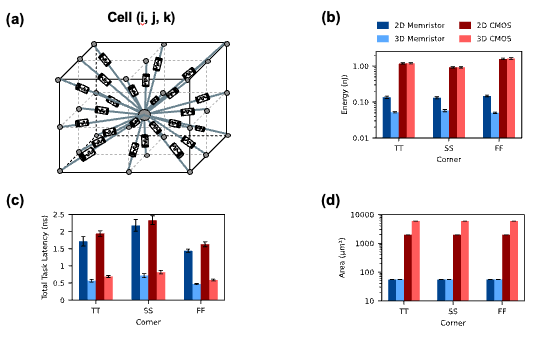
Emerging Memory Devices and Circuits
Memristive cells, 3D arrays, and mixed-signal primitives that make computation native to the memory substrate.
02 / ASSOCIATIVE MEMORY
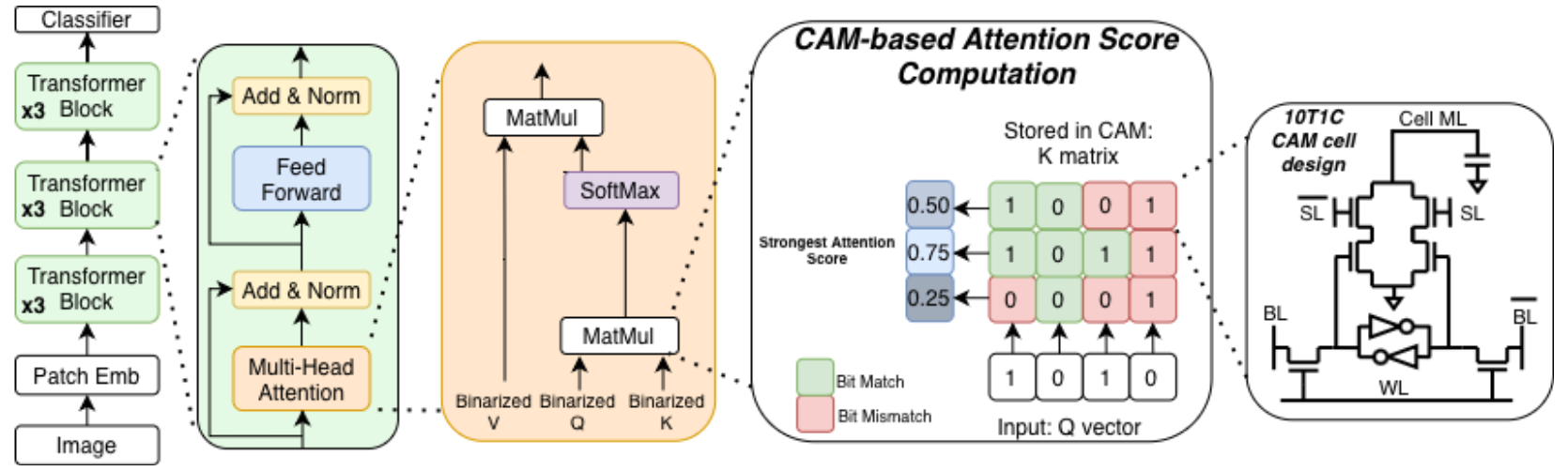
Associative-Memory Architectures
CAM cells and arrays for parallel similarity search, retrieval, and memory-native attention.
03 / SYSTEMS
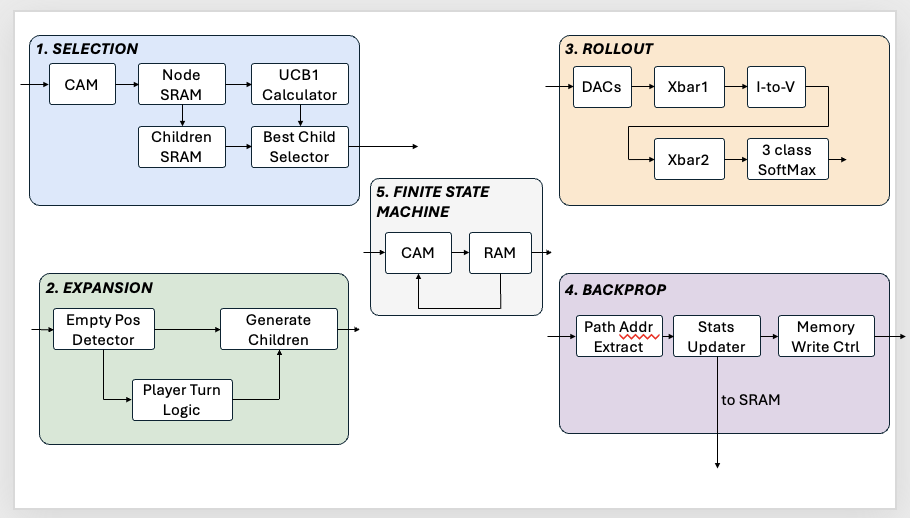
Search and Reasoning Accelerators
Hardware-software co-design for attention, symbolic policies, tree search, and test-time computation.
Explore the research program →
Selected First-Author Work
Multi-primitive in-memory computing for Monte Carlo tree search
Coordinates CAM, SRAM, RRAM, logic, and TCAM control as one accelerator for iterative tree search.
CAMformer: Binary Associative Memory Is All You Need
Recasts transformer attention as associative-memory retrieval using a binary attention CAM.
Advancements in Content-Addressable Memory (CAM) Circuits
A survey of CAM circuits, applications, and future directions in the AI domain.
Biography
I am a Ph.D. candidate in Electrical and Computer Engineering at Duke University, advised by Yiran Chen and Hai "Helen" Li in the Center for Computational Evolutionary Intelligence. I also work with the Emerging Accelerators team at Hewlett Packard Labs. Previously, I earned a B.S. in Electrical Engineering from UMass Amherst and worked with Yingyan Lin on efficient deep learning.
News
May 2026Started as a Research Associate with the Emerging Accelerators team at Hewlett Packard Labs.
Apr 2026CAMformer accepted by IEEE TCAS-I.
Apr 2026Passed my Ph.D. preliminary examination at Duke ECE.
Mar 2026DirectGeMM accepted at ISCAS 2026.
Feb 2026Filed a patent application for an in-memory MCTS accelerator developed at Hewlett Packard Enterprise.