arXiv 2026 · First and Corresponding Author · HPE Labs
Multi-primitive in-memory computing for Monte Carlo tree search
IMC-MCTS decomposes tree search into the memory and logic operations each phase actually needs, then coordinates them as one accelerator.
124.18 mJ
modeled energy per 9×9 Go move at 5,000 search iterations
60.26 mW
modeled sustained accelerator power in the evaluated setup
1,050 games
9×9 Go round-robin evaluation at 500 simulations per move
8 applications
mapped across four domains to test substrate reuse
Problem
Monte Carlo tree search alternates between irregular tree lookup, expansion, learned evaluation, statistical update, and control. A single conventional compute primitive is poorly matched to all five phases, while moving state among separate accelerators can erase the benefit.
Approach
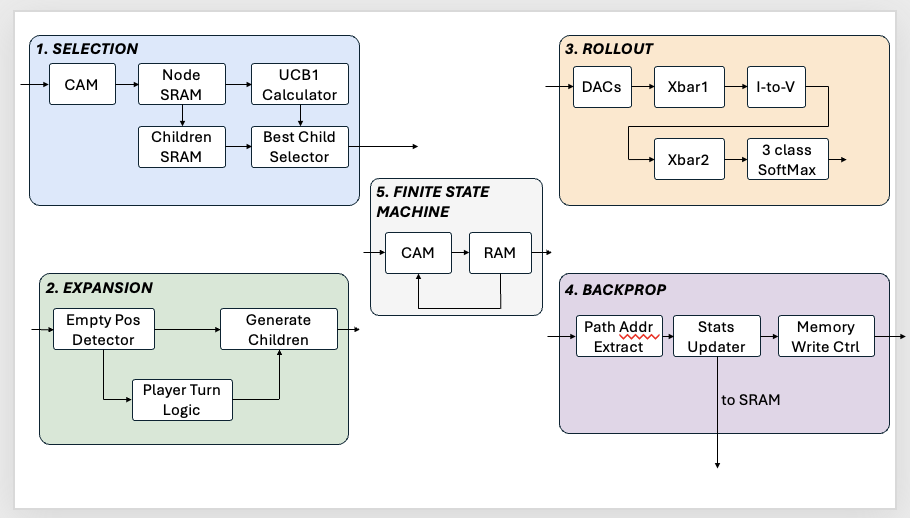
Selection: a 6T SRAM CAM and SRAM locate nodes and evaluate the tree policy.
Expansion: combinational game logic generates legal successor states.
Rollout: a two-layer analog RRAM crossbar evaluates candidate positions.
Backpropagation: SRAM stores and updates visit and reward statistics.
Control: a TCAM finite-state machine coordinates the recurrent search loop.
My Role
I conceived the phase-to-primitive decomposition, designed the architecture, performed RTL synthesis and cycle simulation, ran the Go tournament and cross-domain evaluations, and led the manuscript.
Citation
T. Molom-Ochir, B. F. Morris III, Y. He, A. Gajjar, G. Pedretti, H. Li, Y. Chen, J. Ignowski, and A. Natarajan, "Multi-primitive in-memory computing for Monte Carlo tree search," arXiv:2607.22869, 2026. DOI